
Why Trust and Reliability Matter When Choosing a Shopify Instagram Feed App

Adding an Instagram feed to your Shopify store sounds pretty straightforward. Connect your account, choose a layout, and start showing your latest posts.
But there's quite a bit happening behind that feed.
Your Instagram feed app sits between Instagram and your Shopify store. It needs to fetch photos, Reels, and other content from Meta, deliver it quickly to your storefront, stay connected when platforms change, and do all of that without slowing down the shopping experience.
And Instagram feeds themselves have changed.
They're no longer limited to a row of posts at the bottom of a homepage. Brands are using Instagram content throughout their stores to showcase UGC, add social proof to product pages, create shoppable feeds, highlight products in real-life settings, and help shoppers discover what to buy next.
The more your store relies on that content, the more important the app behind it becomes.
We built Mintt Instafeed to make it easy for Shopify brands to bring Instagram content, UGC, and shoppable feeds into their storefronts without compromising on performance or reliability. We'll use our own app as an example throughout this article, but these are things we'd recommend looking for when choosing any Instagram feed app for Shopify.
Start With the Instagram Connection
An Instagram feed needs a reliable way to get content from Instagram onto your store.
That might sound obvious, but not every app does it in the same way. Some tools have historically relied on scraping or unofficial methods to retrieve Instagram content. Those approaches can be fragile, particularly when Instagram changes something.
The foundation of a reliable Instagram feed is an official connection to Meta.
Mintt Instafeed uses the official Meta API, so content and account permissions are handled through Meta's own infrastructure. This gives merchants a more secure, dependable connection to Instagram - and gives us a stable foundation to keep the app working as Meta's platform evolves.
If you're still figuring out the basics, we have a separate guide on how to add an Instagram feed to Shopify.
Look for an App That's Built for Shopify
The Instagram side is only half of the equation. The app also needs to work well with Shopify.
That's especially important because an Instagram feed lives directly on your storefront. It has to work alongside your theme, product pages, other apps, and whatever else you're using to build the shopping experience.
Mintt Instafeed is Built for Shopify, which means it has met Shopify's standards around areas such as performance, integration quality, and merchant experience.
For us, this is an important trust signal when evaluating any Shopify app - not just an Instagram feed.
It shows that the app hasn't simply been made to work with Shopify. It has been built around Shopify.
Social Proof Shouldn't Come at the Expense of Speed
One of the best reasons to bring Instagram onto your store is social proof.
Your product photography can show a product perfectly lit in a studio. Instagram can show someone actually wearing it, styling it, unboxing it, or using it at home.
That makes the shopping experience feel more real.
It's why brands increasingly bring Instagram content beyond the homepage and onto product and collection pages, where it can help shoppers make decisions. We wrote more about this in our guide to boosting social proof on your Shopify store.
The problem is that Instagram content is also heavy.
High-resolution images, carousels, and video can quickly add weight to a page if they're not handled properly.
A feed that's supposed to improve your storefront shouldn't make the storefront noticeably slower.
Mintt Instafeed uses lazy loading, image compression, and minimal JavaScript to keep feeds lightweight and minimize their impact on page performance. You can read more about how we approach this on our Fast & Secure page.
It's a fairly simple principle: Instagram content should add to the shopping experience without getting in its way.
Shoppable Feeds Raise the Stakes
Instagram content becomes even more useful when shoppers can act on what they see.
With a shoppable Instagram feed, merchants can connect the products shown in a post to the corresponding products in their Shopify store.
So instead of seeing a great outfit on Instagram and having to hunt through a collection for the individual pieces, a shopper can go directly from inspiration to the relevant products.
This is where an Instagram feed starts becoming part of the actual shopping journey rather than just a visual element.
We've covered the setup in our guide to creating a shoppable Instagram feed on Shopify, as well as how fashion brands can use Instagram content to build Shop the Look experiences.
But becoming part of the shopping journey also raises the stakes for reliability.
If shoppers are using your Instagram feed to discover products, a feed that doesn't load isn't just an aesthetic problem. You're potentially losing a path to conversion.
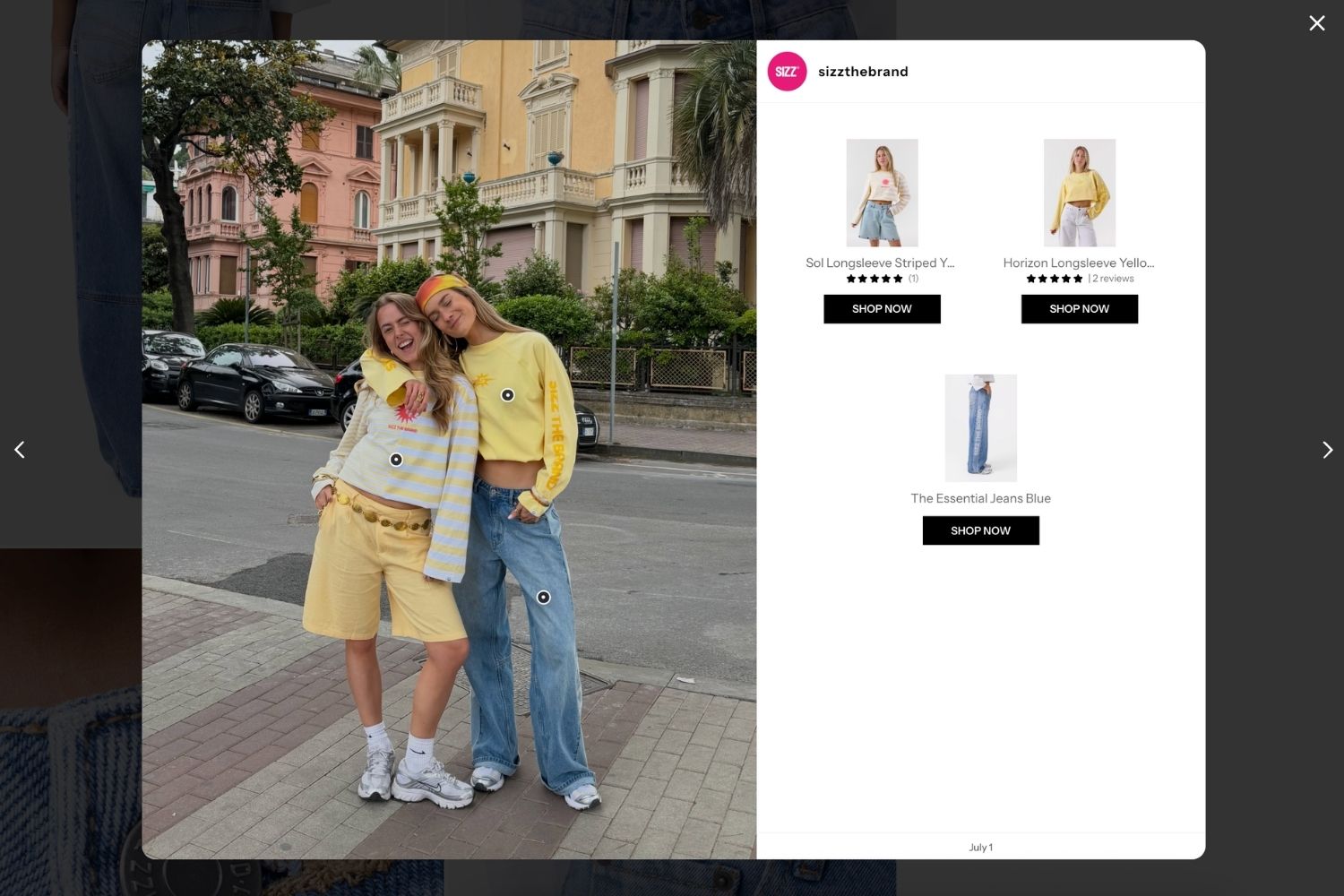
A shoppable Instagram post powered by Mintt Instafeed on the SIZZ The Brand storefront.
The Same Is True for UGC
Instagram is also one of the most natural places to find user-generated content.
Customers tag brands in photos. Creators feature products in Reels. People share how they're using something in ways the brand itself might never have thought to show.
Bringing some of that content onto your Shopify store can make product pages feel much more useful and credible.
Instead of only showing shoppers what you say about a product, you can show them what your customers are doing with it.
With Mintt Instafeed, merchants can use tagged Instagram posts to create curated UGC feeds and bring that content into their storefront.
Our guide to turning Instagram UGC into Shopify conversions goes into the strategy in more detail, and we've also collected some broader UGC best practices for Shopify brands.
Once again, though, the underlying Instagram connection matters.
If UGC is becoming part of your product pages and conversion strategy, you want to know the content will keep showing up without someone on your team constantly checking whether the integration is still working.
Think About Your Busiest Day, Not Your Average One
Most apps work fine when nothing unusual is happening.
Reliability becomes more interesting when your store gets busy.
Maybe it's Black Friday. Maybe you've just launched a new collection. Maybe an influencer mentions your brand or one of your Reels suddenly takes off.
That's precisely when you don't want a storefront app becoming another thing to worry about.
For larger brands, this matters even more because Instagram content may appear in several places across the store: homepage feeds, product-specific feeds, UGC galleries or campaign pages.
Mintt Instafeed is designed to handle high-traffic Shopify stores and traffic spikes without requiring merchants to change how they're using the app. It's designed for Shopify Plus and high-volume brands.
It's worth thinking about scalability before you actually need it. The Instagram feed you add to your homepage today may end up doing considerably more for your store a year from now.
Don't Overlook Privacy and Security
An Instagram feed requires you to connect accounts and authorize access, so it's worth understanding what's happening with that data.
At a minimum, we'd look at how the app authenticates with Instagram, what information it accesses, and whether the company behind it has clear privacy and security practices.
Mintt Instafeed uses Meta's official authentication and API infrastructure and is built in alignment with GDPR and industry data-protection practices.
Security isn't the most exciting feature of an Instagram feed app. Ideally, it's something you rarely have to think about.
That's exactly why it's worth checking before installing one.
Instagram and Shopify Will Change. Your Feed Needs to Keep Up.
Both Instagram and Shopify change constantly.
APIs get updated. Shopify introduces new storefront features. Instagram changes how content and accounts work. Browsers and privacy requirements evolve.
For merchants, most of those changes should be invisible.
That's part of what you're relying on an app developer to handle.
Using official integrations helps, but ongoing maintenance matters too. Mintt Instafeed uses Meta's official API and is built for modern Shopify architecture, including Online Store 2.0 and Shopify Plus.
A reliable app isn't one that never changes.
It's one that keeps changing behind the scenes so that merchants don't have to.
Look Beyond the Instagram Grid
When you're comparing Instagram feed apps, it's tempting to focus on how the feed looks.
That's obviously important. Your feed needs to fit your brand and your storefront.
But we'd look beyond the grid itself.
Think about what you might want Instagram to do for your store over time.
Maybe today you just want your latest posts on the homepage. Later, you might want to make those posts shoppable, build a UGC gallery, put Instagram videos on product pages, create feeds for specific collections, or use customer content as social proof closer to the Add to Cart button.
There are plenty of possibilities. We've put together some creative ways to use Instagram feeds on Shopify, and we've also looked at common Instagram feed mistakes across Shopify stores.
The app you choose should give you room to do more without making your storefront harder to maintain.
Trust Is Mostly About Not Having to Think About It
A good Instagram feed should be something you set up and then use - not something you have to babysit.
Your posts should keep appearing, your UGC should load, your shoppable content should work, your pages should stay fast.
And if your store suddenly gets ten times its normal traffic, the feed shouldn't become the thing that breaks.
That's ultimately what trust and reliability mean to us when we think about an Instagram feed app.
It's also what we've tried to build into Mintt Instafeed: an official Meta integration, Built for Shopify certification, lightweight storefront performance, responsible data handling, and infrastructure that can scale with the merchants using it.
If you'd like to see how we've approached those things, you can explore Mintt Instafeed, read more about our approach to performance and security, or learn about Mintt Instafeed for Enterprise.
Updated by Mintt Studio Team on August 19, 2026

We are a small team building big things as a Shopify Partner. Offering reliable solutions for merchants, our apps reach 900 million customers every month.